
Boring Fixes Beat Sophisticated Tooling Theater
Teams love optimization work that feels advanced. The highest-return fixes are usually the least glamorous: right-sizing, cleanup, shutdown schedules, and deleting what nobody should have kept.

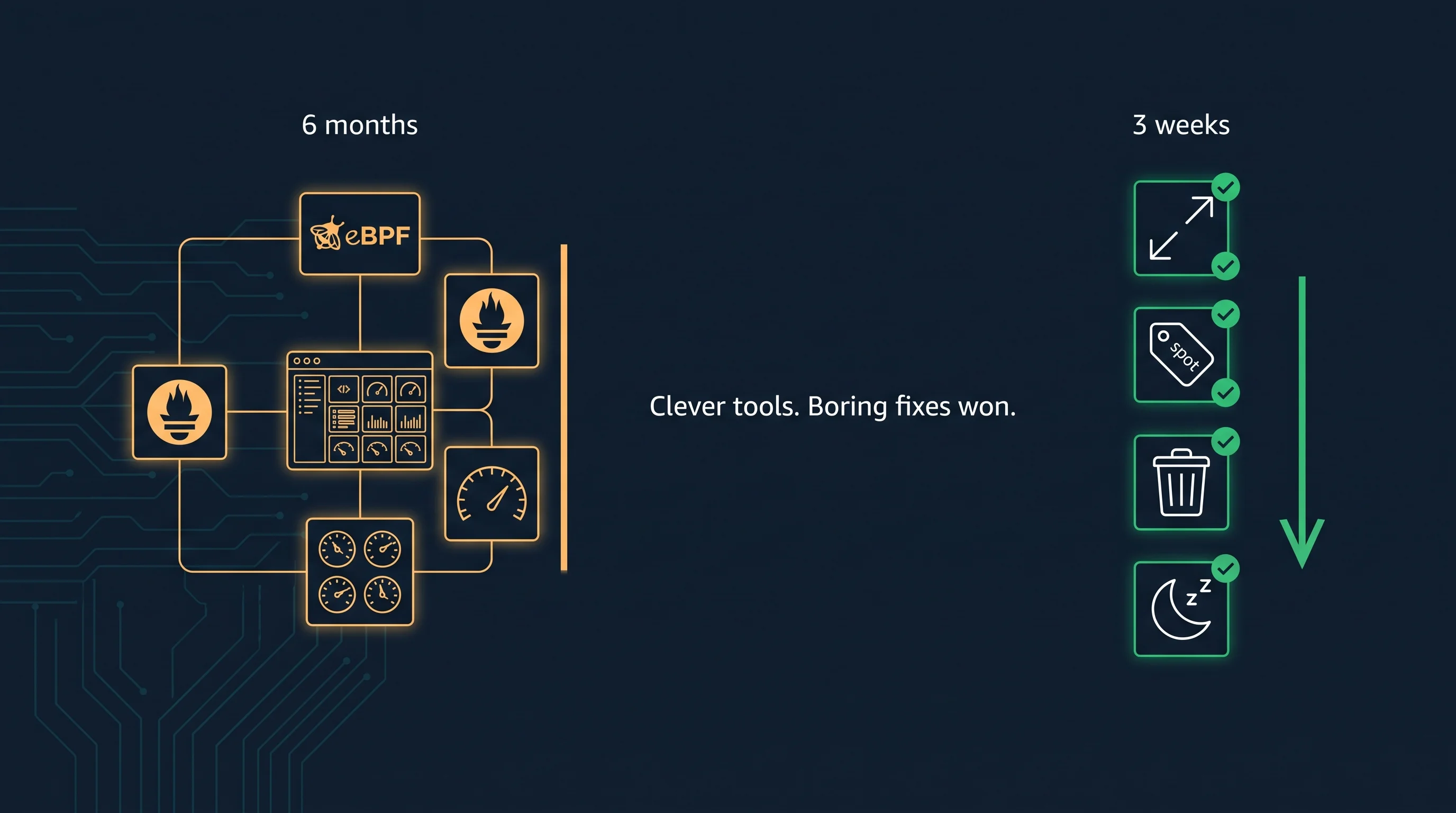
Engineers are often drawn to optimization work that looks intellectually expensive.
Deep Kubernetes tuning.
Exotic dashboards.
Advanced telemetry.
Beautiful theories about efficiency.
Then the bill drops only after someone deletes an orphaned volume, rightsizes a node pool, or turns off a dev cluster at night.
That is not an accident.
Most cloud optimization fails because teams confuse sophistication with leverage.
The Boring Work Usually Has the Highest Return
One recent Kubernetes example captured this perfectly. After months of tuning resource requests, pod density, and more advanced instrumentation, costs reportedly stayed flat. The meaningful savings came from work that feels too basic to headline:
- right-sizing node instance types
- using Spot for workloads that tolerate interruption
- deleting unused namespaces and orphaned persistent volumes
- shutting down dev and staging clusters when nobody was using them
That pattern should not surprise anyone.
Cloud bills are usually inflated by persistent waste, not by lack of sophistication.
Persistent waste survives because it hides inside normal operations.
Nobody feels heroic deleting old PVCs.
Nobody gets conference applause for a schedule that powers down non-production at night.
But those are exactly the controls that change the bill fastest.
Tooling Theater Feels Like Progress
This is the dangerous part.
Sophisticated optimization work often creates the emotional experience of progress long before it creates financial results.
- A new dashboard appears.
- A richer metric stream arrives.
- A platform team debates eBPF, quota design, and the “correct” density target.
- Everyone involved is busy.
That makes the work feel serious.
Meanwhile the obvious problems remain:
- development environments stay online all night
- storage is left attached long after workloads disappear
- oversized instances remain untouched because nobody wants to revisit old assumptions
- unused namespaces continue carrying both spend and residual permissions
This is why the most expensive optimization mistake is often not over-provisioning.
It is organizational attraction to complexity.
Complex work is easier to defend in meetings.
Boring work is easier to delay.
The Same Pattern Shows Up in Security
This is not only a FinOps lesson.
Security teams fall into the same trap constantly.
They invest in advanced controls and still leave the basics unresolved.
The result looks familiar:
- impressive detection coverage, weak ownership hygiene
- sophisticated instrumentation, poor cleanup discipline
- advanced policy debates, stale access paths no one removed
That is why this article belongs in a SecFinOps conversation even though the examples are operational.
The money and the risk are usually trapped in the same neglected basics.
- Unused namespaces are not just waste. They often preserve RBAC edges nobody reviewed.
- Orphaned PVCs are not just storage cost. They may retain sensitive application data far longer than intended.
- Dev clusters running at 2 AM are not only a billing issue. They are an attack surface running without real human attention.
The teams that chase sophistication first tend to miss all three.
Why Basics Underperform Organizationally
The reason boring fixes are neglected is not that teams do not know them.
It is that boring fixes expose uncomfortable truths.
They reveal weak hygiene. They reveal stale ownership. They reveal that the largest savings were available without buying another tool.
That is politically inconvenient.
It is much easier to frame the problem as needing better analytics than to admit nobody was clearing dead infrastructure.
It is much easier to approve a project than to ask why dev environments stayed live for months.
That is why mature cloud operations require discipline more than novelty.
What Good Looks Like
High-quality optimization work usually starts with questions that sound almost embarrassingly simple:
- what is still running that nobody needs
- what is still attached that no workload uses
- what non-production capacity is online outside working hours
- what instance sizes survive only because nobody challenged the original choice
- what storage or namespace artifacts still exist after the service they supported is gone
Those questions do not look advanced.
They do, however, map directly to cash.
And because they map directly to cash, they usually map directly to neglected controls too.
Complexity Is Not the Same as Seniority
There is a useful line from the discussion around this theme: we confuse complexity with value.
That is exactly right.
True seniority is not choosing the most technically stimulating optimization path.
It is choosing the path most likely to change the operating reality.
Sometimes that means a hard architecture decision.
Often it means a very ordinary cleanup list executed with discipline.
The teams that save serious money are rarely the ones doing the most theatrical optimization. They are the ones willing to finish the boring work everyone else keeps stepping around.
That is not less strategic.
It is what strategy looks like when it has to survive the invoice.