
Configuration Drift Is an Ownership Failure Before It Is a Cost Failure
The most expensive cloud incidents often begin with a small configuration change nobody owns economically. The drift is technical. The failure is organizational.

Configuration drift is usually described as a technical problem.
A load balancer setting changes. A route is widened. A retention policy is relaxed. An environment keeps working, so the change disappears into the background until someone notices the cost, the exposure, or both.
That framing is incomplete.
Configuration drift is an ownership failure before it is a cost failure.
One widely shared story from Pinterest made the point starkly. A small load balancer configuration change reportedly went unnoticed for months and turned into millions in unnecessary cloud spend. The memorable number is the bill. The more important number is the number of people who saw the system every day and had no economic reason to question the drift.
That is the real problem.
Drift Gets Expensive When Nobody Owns the Consequence
Most organizations can tell you who changed a setting.
Far fewer can tell you who owns the ongoing cost impact of that setting.
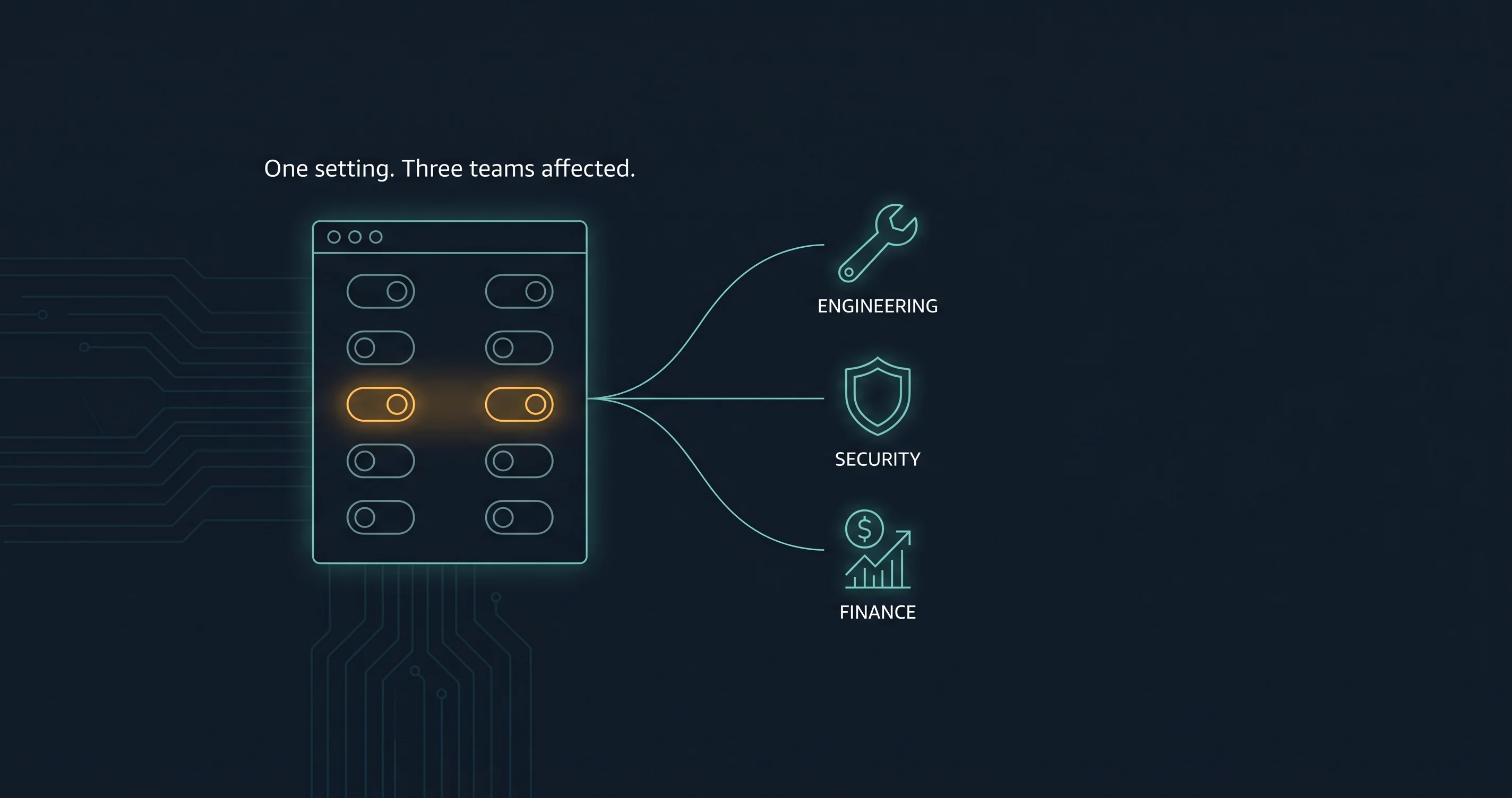
Engineering owns delivery velocity. Finance owns the invoice. Product owns the roadmap. Security owns risk posture. The cloud configuration that binds those four things together often has no single economic owner.
So the same pattern repeats:
- An engineer makes a change that seems operationally harmless.
- The service remains healthy.
- The product team keeps shipping.
- Finance sees a line item grow but cannot map it to a decision.
- Security sees no alert because the system is still technically functional.
What should have been a one-hour review becomes a quarter-end surprise.
The drift was real. The expensive part was the lack of ownership around it.
Cost Drift and Security Drift Share the Same Root
This is why SecFinOps matters. The exact same organizational gap that allows configuration drift to burn money also allows it to weaken controls quietly.
A misconfigured load balancer can do all of the following at once:
- increase request-processing costs
- expose services more broadly than intended
- bypass a protection layer that had been assumed in the threat model
- make incident attribution harder because the final architecture no longer matches the reviewed architecture
Teams tend to split these outcomes into different conversations. Finance treats it as waste. Security treats it as exposure. Platform treats it as a change-management issue.
The cloud does not care which team owns the meeting. The resource changed once. The consequences landed everywhere.
The Dangerous Myth of “Small Settings”
Many expensive incidents start with changes that looked too minor to justify review.
- Not a new system.
- Not a migration.
- Not a redesign.
- Just a setting.
That language is what makes drift dangerous. Calling a change “small” usually means nobody modeled its second-order effects.
Routing behaviour changes traffic patterns. Traffic pattern changes billing. Access-path changes security assumptions. Security assumptions affect what can be exposed, audited, and contained.
The more mature the environment, the more dangerous these “small” settings become because more downstream systems depend on them.
What Good Ownership Looks Like
The answer is not to force every configuration tweak through a heavyweight approval board.
The answer is to make economic ownership explicit.
Good cloud ownership usually has four characteristics:
Every production configuration has a named owner. Not just the team that runs the service. The person who can answer why the current configuration exists and what tradeoff it is making.
Important configuration changes carry an expected cost impact. Not a perfect forecast. A simple answer to: should this make the bill go up, down, or stay flat?
Product and engineering leaders see burn rate near feature velocity. If a product decision changes infrastructure behaviour, the resulting spend cannot remain hidden in a finance console that product never opens.
Drift reviews happen even when the system looks healthy. Healthy runtime behaviour is not proof that the current architecture is still intentional.
That last point matters most. Teams are good at reviewing incidents. They are much worse at reviewing expensive normality.
Dashboards Are Helpful. They Are Not the Fix.
Putting burn rate in front of product managers is useful. It changes incentives. It makes infrastructure decisions more concrete.
But a dashboard by itself is still reactive.
You need the organizational rule that follows from it: when unexplained spend changes after a configuration change, someone must treat that as a first-class engineering event, not as an accounting afterthought.
That rule is what turns dashboards into accountability.
Without it, teams just become better at watching drift happen in real time.
Fact-check: Is Configuration Drift Mainly a Tooling Problem?
No. Tooling helps you detect drift. It does not tell you who should care enough to stop it.
The hard part is not spotting that a setting changed. The hard part is making cloud cost, service behaviour, and security posture belong to the same decision-maker before the invoice forces the conversation.
That is the ownership layer most organizations are still missing.
Try CostObserver. Read-only access, no credit card, connects in minutes. Or explore the demo without signing up.