
A Failed ECS Deployment Can Turn Your NAT Gateway Into a Cost Alarm
When ECS keeps retrying unhealthy deployments over the wrong network path, the bill becomes your first observability signal. The real problem is not NAT Gateway pricing. It is unmanaged data paths.

Most NAT Gateway cost advice focuses on the usual checklist.
Add S3 endpoints. Add DynamoDB endpoints. Right-size non-production. Consolidate where appropriate.
That advice is correct. It also misses a more operational problem.
Sometimes the NAT Gateway is not expensive because the architecture was planned badly.
It is expensive because a deployment kept retrying through a data path nobody thought about until the bill moved.
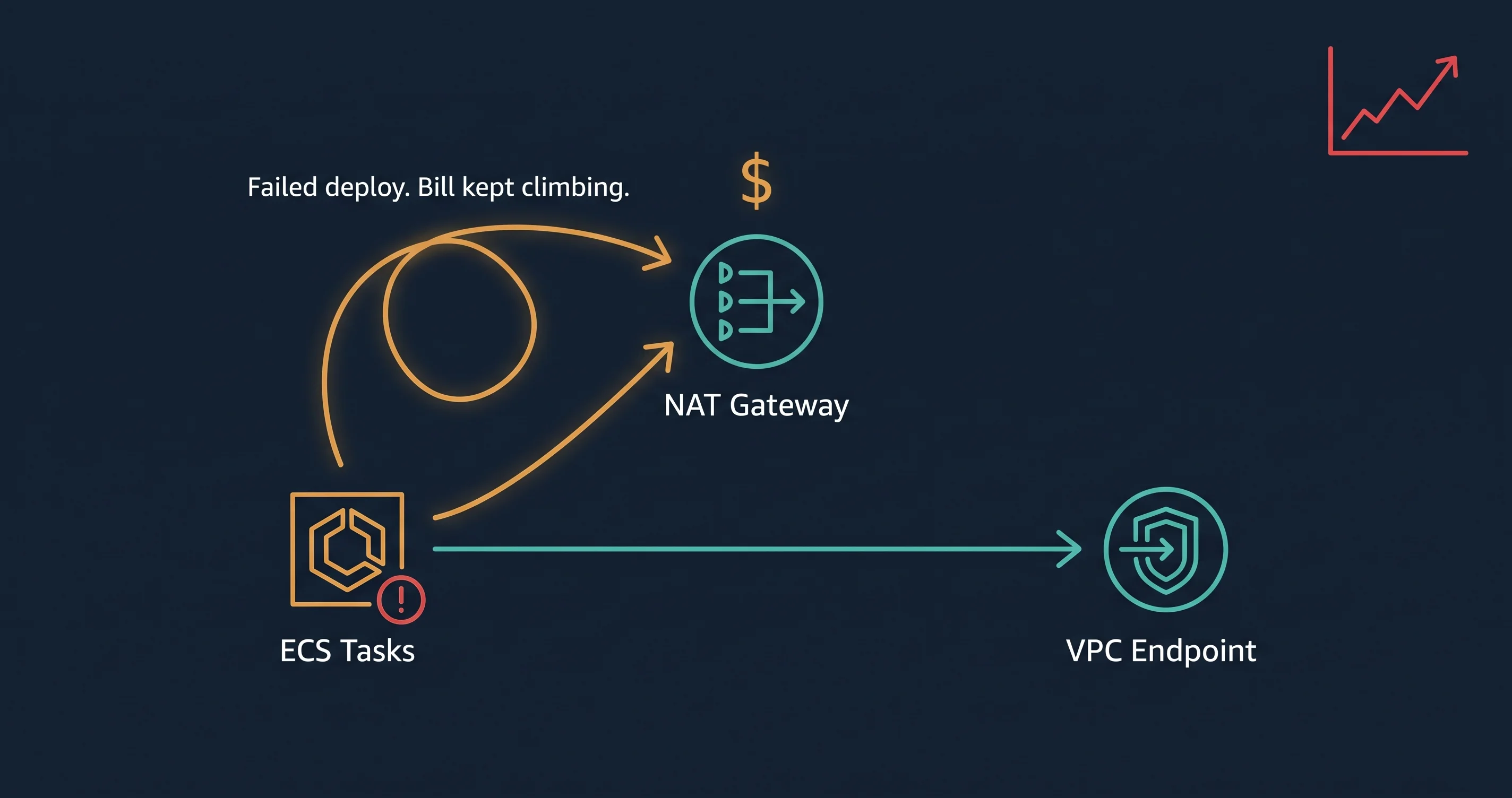
One shared example from an ECS staging environment captured this perfectly. A blue-green deployment went out before a holiday. Several services never turned healthy. ECS kept trying to pull images from ECR repeatedly. The environment did not use an ECR VPC endpoint, so the traffic traversed the public path through a NAT Gateway. Daily spend doubled before anyone connected the bill to the deployment.
This is not really a NAT Gateway story.
It is a data-path governance story.
The Cost Spike Was a Symptom, Not the Failure
At first glance the incident looks like a simple pricing issue:
- Repeated image pulls cost money.
- NAT Gateway processing adds up.
- Add the endpoint, save the bill, move on.
That is not wrong, but it is incomplete.
The more useful question is why a failing deployment was allowed to retry over an expensive and less-controlled path without generating a stronger operational signal.
The system was telling the team something important:
- the deployment was unhealthy
- the retry behavior was persistent
- the image-pull path depended on public routing
- the staging environment lacked a financial or network guardrail that would have made this obvious sooner
The daily cost increase was the only signal broad enough to cut across all four facts.
That is why the incident matters.
Public ECR Paths Are a Security Smell Too
Pulling container images from ECR through a NAT Gateway is not just a cost issue. It is also a sign that the environment depends on a broader egress path than it needs.
With ECR interface VPC endpoints, image pulls can stay on the AWS network rather than traversing internet-routable egress paths. That reduces NAT spend, but it also makes the network architecture more intentional.
Fewer public-path dependencies mean fewer routes to reason about during an incident.
When teams say they care about private-subnet architecture, this is one of the decisions that proves whether they actually do.
Deployment Retries Are an Economic Behavior
A blue-green deployment retry loop is usually framed as a reliability problem. Service does not turn healthy. The deploy keeps trying. Someone fixes the health check. End of story.
In cloud systems, retry loops are also economic behavior.
Every retry can produce compute, data transfer, logging, and control-plane activity. Once the loop crosses a network boundary or touches a paid service repeatedly, the architecture starts billing the bug.
The cloud does not distinguish between successful behavior and repeated failed behavior when it comes to metering. It charges for both.
Most teams do not review it that way.
What Good Looks Like
The fix here is not complicated, but it has to be layered.
Keep ECR traffic private. Use the ECR VPC endpoints so routine image pulls do not depend on NAT at all.
Enable deployment circuit breakers. ECS deployment circuit breaker exists for exactly this kind of failure mode. If tasks are not stabilizing, stop the rollout instead of metering the same failure repeatedly.
Watch the right cost line. Teams often monitor ECS service health and miss the adjacent cost category. For this class of incident, EC2 Other and NAT Gateway data processing are often more revealing than the ECS service bill itself.
Treat pre-holiday changes differently. If a deployment goes out before a low-observability window, the post-deploy watch period should be stricter, not looser. The cloud will keep amplifying failure while the team is offline.
Document network paths as part of platform design. Most organizations document service ownership and deployment flows. Far fewer document which paths are private, which paths depend on NAT, and what each path costs when something retries unexpectedly.
That missing map is what turns a routine failed deployment into a billing surprise.
NAT Gateway Is Not the Villain
NAT Gateway pricing is well understood. The problem is usually not the meter.
The problem is that teams do not know which workloads still rely on it, under what failure modes, and with what retry behavior. That is how cost becomes your first observability layer instead of your last one.
Once you see it that way, the incident stops being about one ECS deployment. It becomes a design review question.
Which data paths in your environment are still expensive, public, and largely invisible until something fails repeatedly?
That is a much more useful question than whether NAT Gateways are too expensive in the abstract.
Try CostObserver. Read-only access, no credit card, connects in minutes. Or explore the demo without signing up.