
FinOps Without SecOps Is Just Expensive Guesswork
Two teams. Two dashboards. Two investigations of the same incident. The real cost of keeping FinOps and SecOps separate is not the tools. It is the time, the mistakes, and the compliance violations hiding in the gap between them.

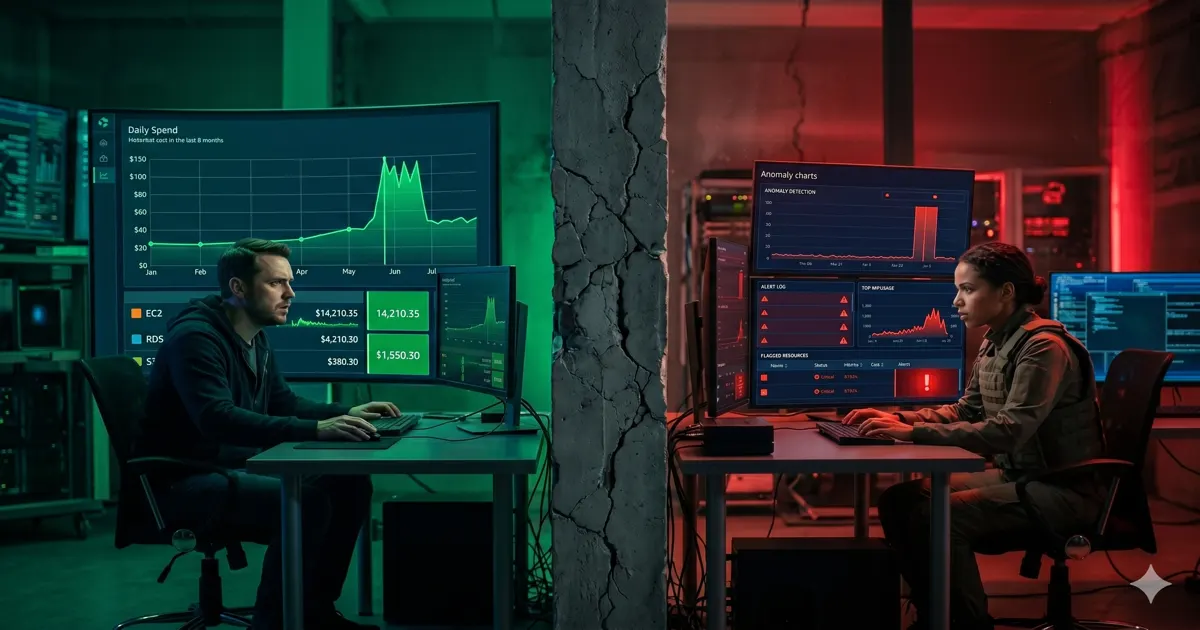
FinOps and SecOps are the two fastest growing disciplines in cloud engineering. They also actively hate each other’s dashboards.
FinOps lives in native billing tools and third-party cost platforms. SecOps lives in SIEMs, CSPMs, and threat detection feeds. When a cloud incident happens, both teams open their respective tools, start separate investigations, and spend the first 48 hours arguing about whether the problem is a cost issue or a security issue.
It is always both. That is the part nobody built a process for. The FinOps Foundation framework explicitly calls out the need to align cost management with security and compliance boundaries. Most teams have not read that section.
The Dual Ticket Problem
A 200% spike in data transfer costs lands in the AWS bill on a Tuesday morning.
The FinOps team opens a Jira ticket: “Network optimisation: investigate data transfer anomaly.” They filter Cost Explorer by service, identify S3 as the source, and start looking at bucket configurations and lifecycle policies.
The SecOps team gets a separate PagerDuty alert the same morning: “Potential data exfiltration: unusual S3 GetObject volume.” They open their SIEM, pull the access logs, and start correlating IP addresses against known threat feeds.
Both teams are investigating the same S3 bucket. Neither team knows the other has a ticket open. The FinOps team finds a misconfigured bucket policy and closes their ticket as resolved. The SecOps team is still investigating three days later.
The company paid for the data transfer. It paid two engineering teams to investigate the same event independently. And it paid the cost of a three-day delayed response because nobody connected the two tickets.
That is not a tooling problem. It is an organisational one. And it compounds every time an incident touches both cost and security, which is more often than most teams realise.
The Right-Sizing Mistake That Costs More Than It Saves
FinOps teams are measured on savings. That incentive is correct. But savings without context is where the expensive mistakes happen.
A standard FinOps review identifies 40 idle staging databases across three AWS accounts. Combined cost: $4,000/month. Recommendation: terminate. The ticket is approved, the databases are deleted, and the saving is logged.
Six weeks later, a compliance audit surfaces a problem. Three of those databases contained unscrubbed PII cloned from production during a load testing exercise four months earlier. The instances are gone. The data destruction records do not exist. The compliance team now has to reconstruct what was in those databases, who had access, and whether any of it was exposed before deletion.
The cost of that reconstruction, the legal review, and the potential regulatory exposure is not $4,000. It is not even close to $4,000.
The FinOps team did exactly what they were supposed to do. They had no visibility into the compliance tags on those databases because compliance context lives in a different system, reviewed by a different team, on a different schedule. The AWS Well-Architected Framework Security Pillar is explicit on this point: data classification and governance cannot be bypassed in the name of cost optimisation. The saving was real. The risk it created was larger.
Cost optimisation without security and compliance context is not optimisation. It is guesswork with a spreadsheet attached.
The Dashboard Tax Nobody Measures
Count the tools in a typical mid-size engineering organisation.
FinOps: native billing consoles, a third-party cost management platform, a spreadsheet for chargeback, and a weekly review deck.
SecOps: a SIEM, a CSPM, a native threat detection feed like GuardDuty, a vulnerability scanner, and a separate ticketing queue.
The licensing cost of that stack is visible. The operational cost is not.
A VP of Engineering sits in a weekly review translating between two teams who cannot see each other’s reality. The FinOps lead presents a rightsizing recommendation. The SecOps lead flags a compliance concern on the same resource. The VP asks whether anyone has looked at both signals together. Nobody has. The meeting ends with an action item to “align offline.”
That alignment meeting happens the following week. Or the week after. Or not at all, because both teams have their own priorities and their own metrics and their own definition of what “resolved” means.
The cost of that misalignment is not on any dashboard. It is in the engineering hours spent on duplicate investigations, the delayed responses, and the decisions made with half the context.
Fact-check: Is this a people problem or a process problem?
Neither, entirely. The teams are doing their jobs correctly within their defined scope. The gap is structural. FinOps and SecOps were built as separate disciplines with separate tooling, separate reporting lines, and separate success metrics. The cloud does not respect that separation. A single misconfigured resource generates both a cost signal and a security signal simultaneously. The organisational structure was not designed for that.
What Changes When the Two Teams Share a View
The dual ticket problem does not require a reorganisation to fix. It requires a shared signal.
When a data transfer spike surfaces with the corresponding S3 access log activity already attached, the FinOps team and the SecOps team are looking at the same event from the first moment. The Jira ticket and the PagerDuty alert become one investigation, not two.
When a rightsizing recommendation surfaces with the compliance tags and security posture of the resource already visible, the FinOps team can make the call without waiting for a SecOps review. The $4,000 saving either proceeds cleanly or gets flagged before the deletion, not six weeks after.
When the dashboard tax is replaced by a single view that both teams can read, the VP of Engineering stops translating and starts deciding.
That is the operational shift SecFinOps enables. Not fewer tools. Not a reorganisation. A shared context layer that makes the existing tools tell the same story.
The expensive guesswork stops when both teams are looking at the same incident at the same time.
Try CostObserver. Read-only access, no credit card, connects in minutes. Or explore the demo without signing up.