
KMS Re-Encryption Costs Are an Encryption Governance Signal
When KMS charges spike during S3 re-encryption, the surprise is not only financial. It means the team started an encryption change without understanding the governance, audit, and call-volume implications first.

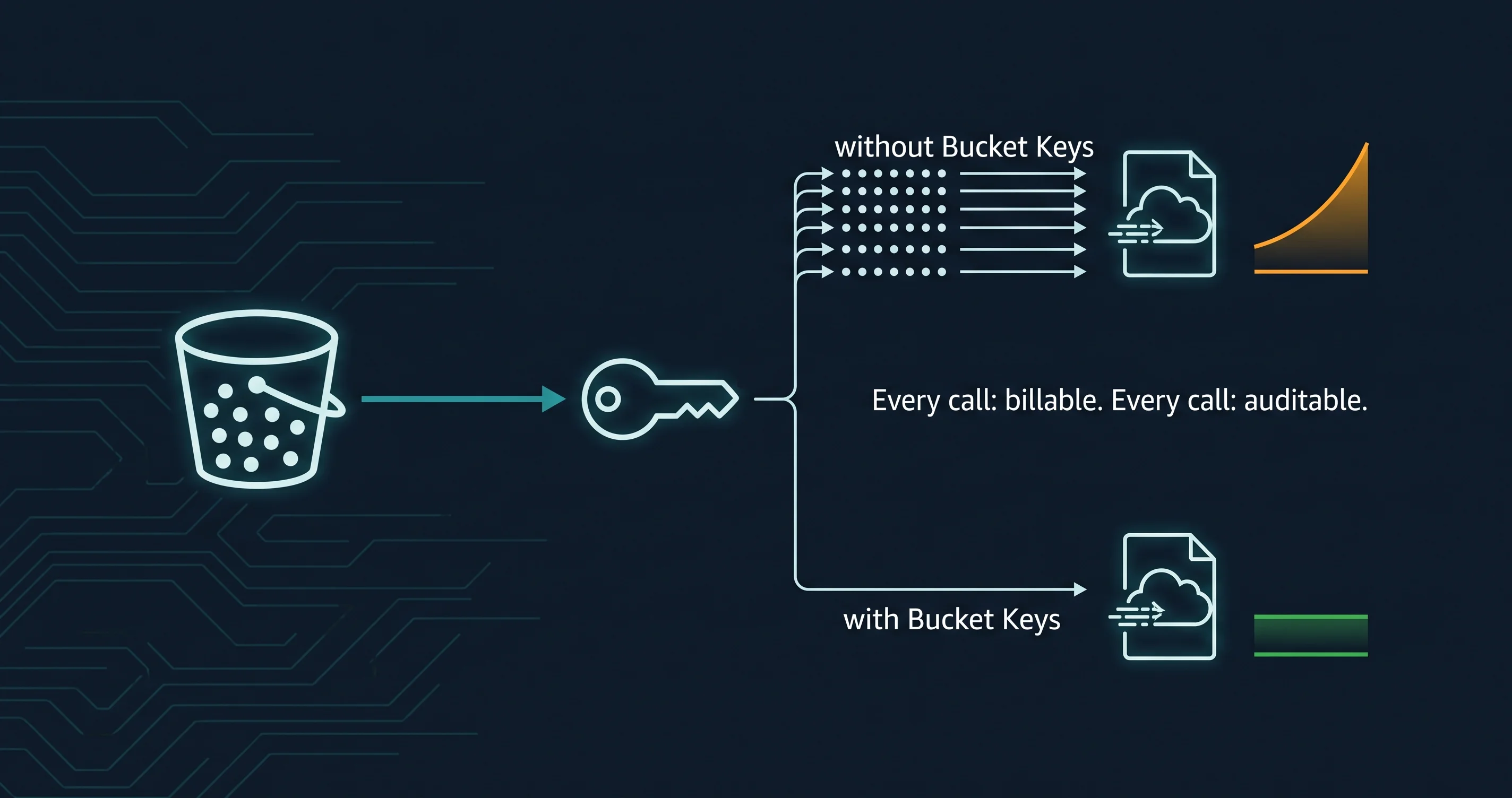
Teams often treat encryption changes as a security-only decision.
Turn on a stronger control.
Re-encrypt the bucket.
Standardize key usage.
Move on.
Then the KMS bill jumps and everyone acts surprised.
That surprise is the real signal.
If KMS costs spike during S3 re-encryption, the organization did not fully understand its encryption path before touching production data.
That is not just a billing oversight.
It is an encryption governance gap.
The Cost Spike Usually Means the Team Started Blind
One cloud engineer recently documented this exact pattern while trying to understand why S3 re-encryption caused unexpected KMS charges. The important lesson was not that AWS pricing can be confusing. The important lesson was that the encryption flow in practice was poorly understood until the bill forced the team to map it.
That is backwards.
If you only learn how your encryption path behaves after the invoice arrives, you did not have governance before the change.
You had hope.
Encryption work should begin with three questions:
- what exact KMS operations will this change generate
- how does the workload behave with and without Bucket Keys
- what audit trail will those operations create in CloudTrail and adjacent logging systems
If those answers are unknown, you are not ready to call the work controlled.
Every KMS Call Is Both Billable and Auditable
This is where the SecFinOps lens matters.
A KMS API call is not only a unit of cost.
It is also a security-relevant event.
That means KMS activity has at least three consequences at once:
- it affects spend
- it affects the observable audit trail
- it reflects real encryption behavior, not just policy intent
When teams re-encrypt large S3 object sets without understanding call amplification, they often under-model all three.
They do not just under-budget the KMS line item.
They also under-budget the surrounding operational impact: CloudTrail volume, review effort, and the blast radius of a poorly planned change.
The cost spike is simply the clearest signal that the system is doing more cryptographic work than the team anticipated.
That should trigger a governance review, not just a pricing review.
Bucket Keys Matter Because Architecture Matters
The practical detail is important here.
Without S3 Bucket Keys, every object PUT and GET can generate separate KMS activity. At scale, that compounds quickly.
With Bucket Keys, a bucket-level data key can be cached, which reduces the number of direct KMS interactions materially.
That is not a minor optimization.
It changes the economics of encryption-heavy workflows.
More importantly, it changes the predictability of those workflows.
Predictability is what governance needs.
If two architectures deliver the same security outcome but one has far more understandable cost and event behavior, the more predictable design is usually the better operating choice.
That is especially true when teams are running bulk re-encryption jobs under time pressure.
The Workflow Matters Too
There is another detail teams miss.
Since January 2026, AWS has offered UpdateObjectEncryption, which is purpose-built for changing encryption settings on S3 objects. That matters because too many teams still reach instinctively for CopyObject-style workflows that introduce more complexity and more opportunities to misunderstand the underlying path.
The rule here is simple.
If AWS gives you a purpose-built control-plane mechanism for a security-sensitive operation, defaulting to the older workaround should require a reason.
Not the other way around.
The more improvised the workflow, the harder it becomes to predict KMS volume, logging volume, retry behavior, and rollback complexity.
Why This Is Not Just a FinOps Lesson
The common interpretation is: the team needed better cost estimation.
That is true, but incomplete.
The deeper issue is that teams who do not understand their encryption flow well enough to price it often do not understand it well enough to audit it either.
They cannot answer basic governance questions confidently:
- which data paths generate KMS requests
- which applications will experience changed latency or retry patterns
- which identities are invoking the keys at what rate
- which logging streams will expand during the operation
- which anomalies would indicate misuse versus expected bulk activity
Those are not accounting questions.
They are control questions.
The cloud bill just exposes them first.
What Good Looks Like
Strong teams do not treat re-encryption as a narrow security project.
They treat it as a cross-functional change with explicit economic and audit consequences.
That means:
- Model expected KMS call volume before the change.
- Decide explicitly whether Bucket Keys are required.
- Choose the right API path for the re-encryption method.
- Forecast CloudTrail and log impact alongside direct KMS cost.
- Define what successful and abnormal behavior look like before execution starts.
That last point matters most.
If you do not know what normal looks like during an encryption operation, you will not know whether a cost spike is expected, accidental, or suspicious.
The Right Interpretation of the Bill
When KMS costs jump during re-encryption, the bill is telling you something useful.
It is telling you the organization changed an encryption surface without first creating a shared model of how that surface behaves.
That is why the right response is not only to reduce the cost.
It is to improve the governance that should have existed before the first object was touched.
Encryption that is financially opaque is usually operationally opaque too. And operational opacity is where both security mistakes and budget surprises start.