
Least Privilege Makes the Most Expensive Lambda Mistakes Architecturally Impossible
A runaway thumbnail loop is usually framed as a missing S3 prefix. The deeper failure is permission design that allowed the function to trigger on its own output in the first place.

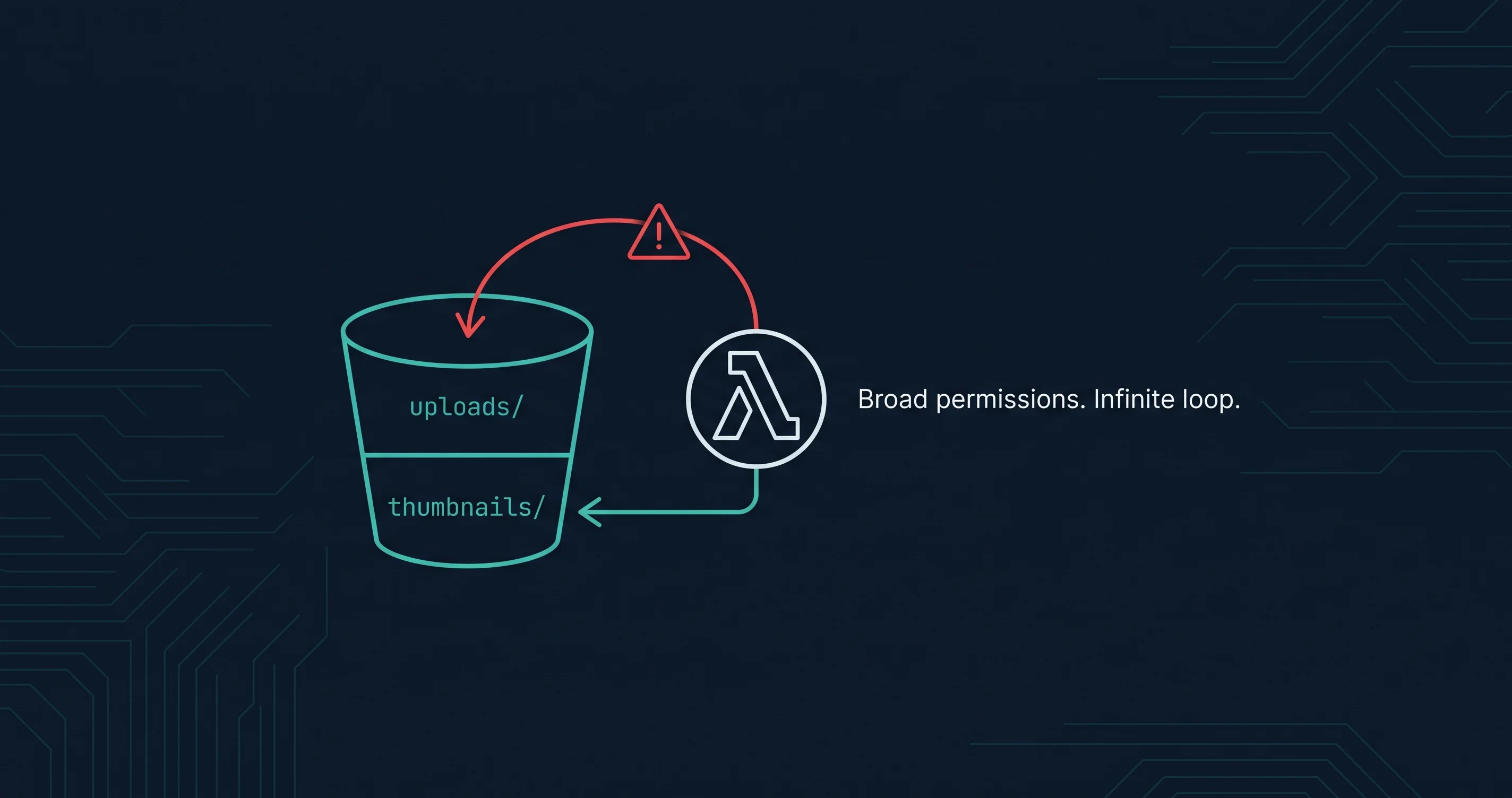
Most teams describe a runaway thumbnail Lambda as a bucket notification mistake.
That is incomplete.
The missing prefix is only the last visible symptom.
The deeper failure is that the function was allowed to read from and write back into the same trigger surface without hard architectural boundaries.
That is a least-privilege problem.
One widely shared example made the pattern obvious. A photo upload Lambda created thumbnails and wrote them back into the same bucket. Because the trigger scope was too broad, the thumbnail upload triggered the function again. Then the new thumbnail triggered it again. One small configuration miss became a self-feeding loop. The bill reportedly reached $4,500 in two days, with a much larger monthly forecast behind it.
Most writeups stop at the bucket prefix.
They should stop at the permission model.
The Prefix Was the Symptom
If a function is triggered by uploads/, and it is only allowed to write to thumbnails/, the loop is structurally harder to create.
If the trigger listens to the whole bucket and the function can write anywhere in the bucket, the system is trusting human care where it should have been enforcing policy.
That difference matters.
When teams say the outage happened because someone forgot a prefix, they are describing the final defect in the chain. They are not describing the design choice that made the defect expensive.
The cloud scales whatever permissions you give it. If the permissions are broad, it scales broad mistakes.
Least Privilege Is Also a Spend Constraint
Security teams already understand least privilege as blast-radius reduction.
- A function should only access the objects it needs.
- A role should only invoke the APIs it genuinely requires.
- A workflow should only write into the resources it is designed to mutate.
That exact same discipline is also a financial control.
Why?
Because the most expensive cloud failures are usually not expensive because compute is inherently costly. They are expensive because automation was allowed to repeat the wrong action at cloud speed.
The minute a function can:
- read from a source broadly
- write back into that same source broadly
- scale concurrency automatically
- keep retrying without a stopping condition
you no longer have a single bug.
You have an unbounded economic behavior.
Least privilege narrows the behavior surface.
That means it narrows the cost surface too.
The Real Design Failure Is Shared Surfaces
This is the architectural smell behind many cloud incidents: the same surface is both the trigger and the output.
That is true in S3-triggered Lambdas, event-driven queues, scheduled remediations, and control-plane automations.
The problem is not just recursion.
The problem is ambiguity.
When the system cannot clearly distinguish inbound work from generated output, small mistakes can become self-generated workloads.
Good boundary design usually looks boring:
- one prefix for raw uploads
- one prefix for processed artifacts
- one role limited to the input path
- one role limited to the output path
- one event rule that only listens to the input path
- one concurrency ceiling that keeps failure small
That is not glamorous architecture.
It is safe architecture.
And safe architecture is almost always cheaper than clever architecture.
Why This Is a SecFinOps Problem
The traditional split looks like this:
- platform says it was a configuration mistake
- security says there was no breach
- finance says the bill spiked unexpectedly
But those are not separate events.
They are one event viewed through three departments.
The same missing boundary that allowed the loop also tells you the system had weak control design.
If a compromised function, a bad deployment, or a rushed developer change can trigger unbounded self-generated actions, you have both a security weakness and a financial weakness.
This is exactly where SecFinOps earns its keep.
It asks a different question:
What permission or boundary decision made this behavior possible at all?
That question gets to the root faster than asking who forgot which config line.
The Best Cost Alert Is a Design That Prevents the Spend
Yes, budget alerts matter.
Yes, anomaly detection matters.
Yes, concurrency alarms, dead-letter queues, and retry caps should all be present.
But those are secondary controls.
They are there because the primary control failed.
The strongest possible control is to make the bad loop impossible to express.
That means:
- the trigger only watches approved input paths
- the function cannot write back into those paths
- the role cannot mutate adjacent resources casually
- the architecture distinguishes source from output clearly
If that is true, a forgotten prefix is annoying.
If that is not true, a forgotten prefix is expensive.
What Good Looks Like
If you want a practical test, use this one.
Look at every event-driven automation and ask:
Can this component observe, trigger, and write back into the same surface without a hard boundary?
If the answer is yes, the control failure is already present even if the incident has not happened yet.
That is the operational version of least privilege.
- Not a policy PDF.
- Not a quarterly review checkbox.
- A system design choice that prevents both blast radius and runaway spend.
Cloud systems do not care whether you classify the damage as security, operations, or cost.
They only care what behavior you allowed.
That is why least privilege is not just about compromise.
It is about making the expensive mistake impossible.