
Least Privilege Is a Cost Control
Least privilege is usually sold as blast-radius reduction after compromise. In cloud systems, it also prevents financially dangerous actions from being possible in the first place.

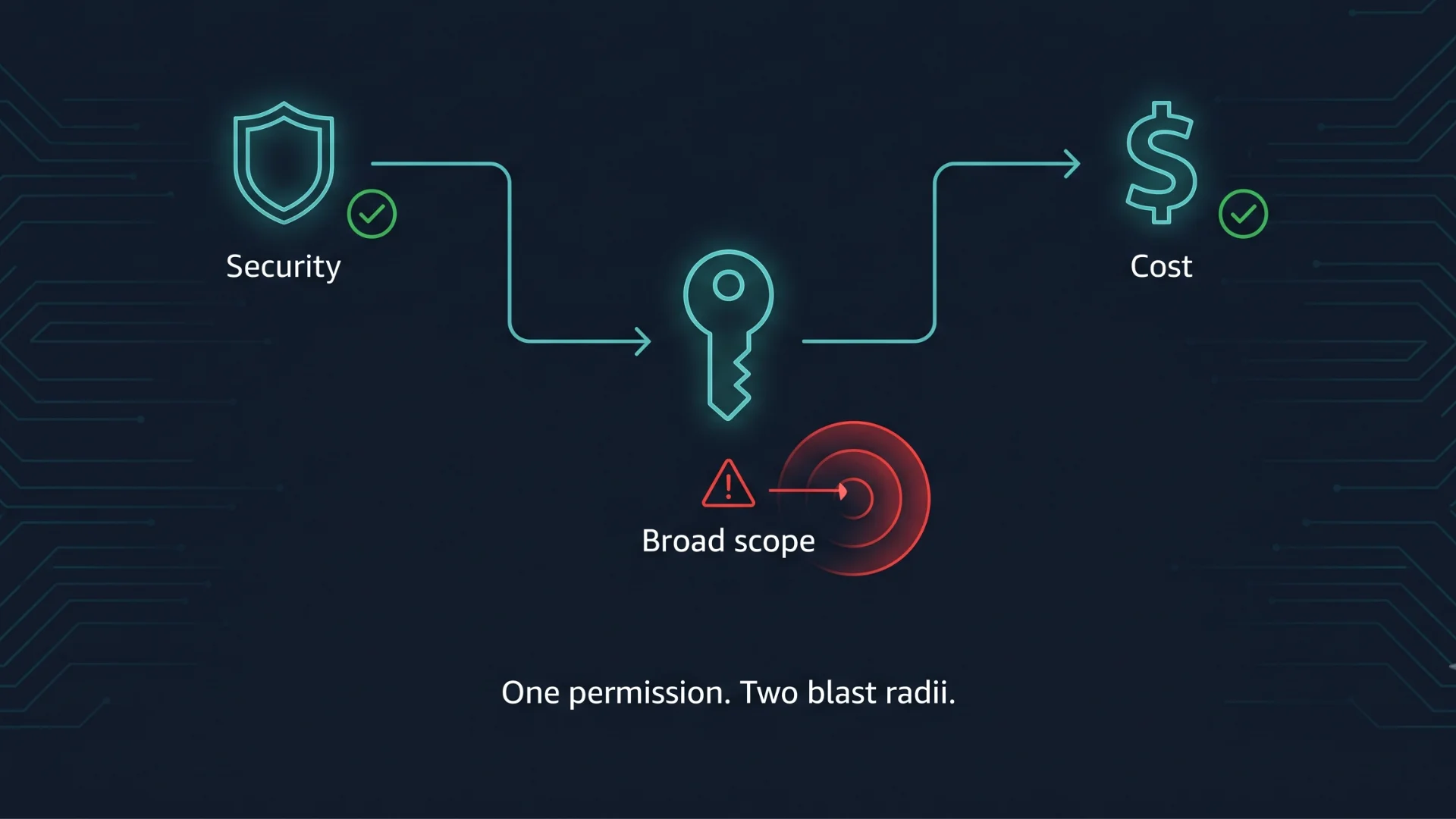
Least privilege is usually explained in defensive language:
- Limit the blast radius.
- Reduce access.
- Constrain what an identity can do if it is misused or compromised.
All of that is true. It is also incomplete.
In cloud environments, least privilege is not just a post-compromise safety measure.
It is a cost control.
It prevents economically dangerous actions from being possible in the first place.
Most Expensive Incidents Are Permission Problems in Disguise
When cloud spend explodes, teams usually start with the symptom:
- The Lambda loop.
- The misrouted data path.
- The runaway retry pattern.
- The unbounded logging bill.
Those stories are useful, but they can be misleading if they stop at the runtime behavior.
In many cases the deeper question is simpler.
What identity, function, or automation had enough freedom to make that behavior possible at cloud scale?
That is a least-privilege question.
Not because an attacker was involved.
Because the permission model defined the economic blast radius of an ordinary mistake.
Permission Scope Defines Cost Scope
This is the part many teams miss.
A broad permission is not only a security risk.
It is permission to create spend.
If a function can write broadly across a bucket, invoke downstream services without tight scope, or generate logs and retries without practical bounds, the role attached to that function is also a financial capability.
The system may still be secure in the narrow sense that no unauthorized human used it.
But it is not economically controlled.
The cloud will faithfully execute the permissions you grant. If those permissions allow repeated, self-amplifying, or unnecessary actions, you have already created an expensive path.
The Wrong Mental Model Is “Security vs Cost”
Organizations often separate the conversations.
Security owns IAM hygiene.
FinOps owns the bill.
Platform owns operational reliability.
That division makes the permission story feel narrower than it is.
But an IAM policy is not just an access statement.
It is a behavioral contract.
It determines:
- what resources a workflow can touch
- how widely a bug can propagate
- what downstream services can be called
- how much cloud activity can be created before another control notices
That means it determines financial exposure too.
Least privilege does not merely reduce the damage after something goes wrong.
It reduces the number of expensive things the system is even capable of doing.
Good Security Design Often Looks Like Economic Restraint
Think about the cloud controls that consistently prevent both classes of failure:
- restricting write paths so automations cannot trigger on their own output
- separating input and output surfaces in event-driven workflows
- scoping roles so remediation jobs cannot mutate unrelated resources
- limiting who can create or scale expensive services without review
- defining service boundaries so logs, storage, and compute growth do not become uncontrolled side effects
None of these are usually described as cost controls. They should be.
They are design decisions that reduce the space in which bad spend can emerge.
That matters because most cloud waste is not malicious.
It is authorized behavior that should never have been authorized so broadly.
Why This Matters More Than Another Alert
Budget alerts are necessary.
Anomaly detection matters.
Approval workflows matter.
But all of those are secondary controls.
They react after the permission model has already allowed the bad behavior to exist.
Least privilege is primary.
It shapes the system before the first invocation, deployment, or retry ever happens.
That is why I think the strongest cost programs will increasingly look like security architecture, not just finance reporting.
They will focus on making the expensive mistake impossible or at least materially harder.
The Better Question to Ask
When reviewing cloud changes, teams often ask: what will this cost?
That is useful but late. The more valuable question is:
What permissions would allow this to become expensive faster than we could notice?
That question changes the design conversation immediately.
It pushes people away from retrospective alarms and toward preventive boundaries.
It forces cost and security into the same architectural discussion.
That is where they belong.
Least privilege is not just about distrust.
It is about restraint.
And in the cloud, restraint is one of the most practical cost controls you can build.