
Monitoring Sprawl Is a Security Blind Spot Before It Is a Tooling Cost Problem
Five monitoring tools do not create five times the visibility when nobody owns the combined signal. They create fragmented alerts, duplicated spend, and missed incidents.

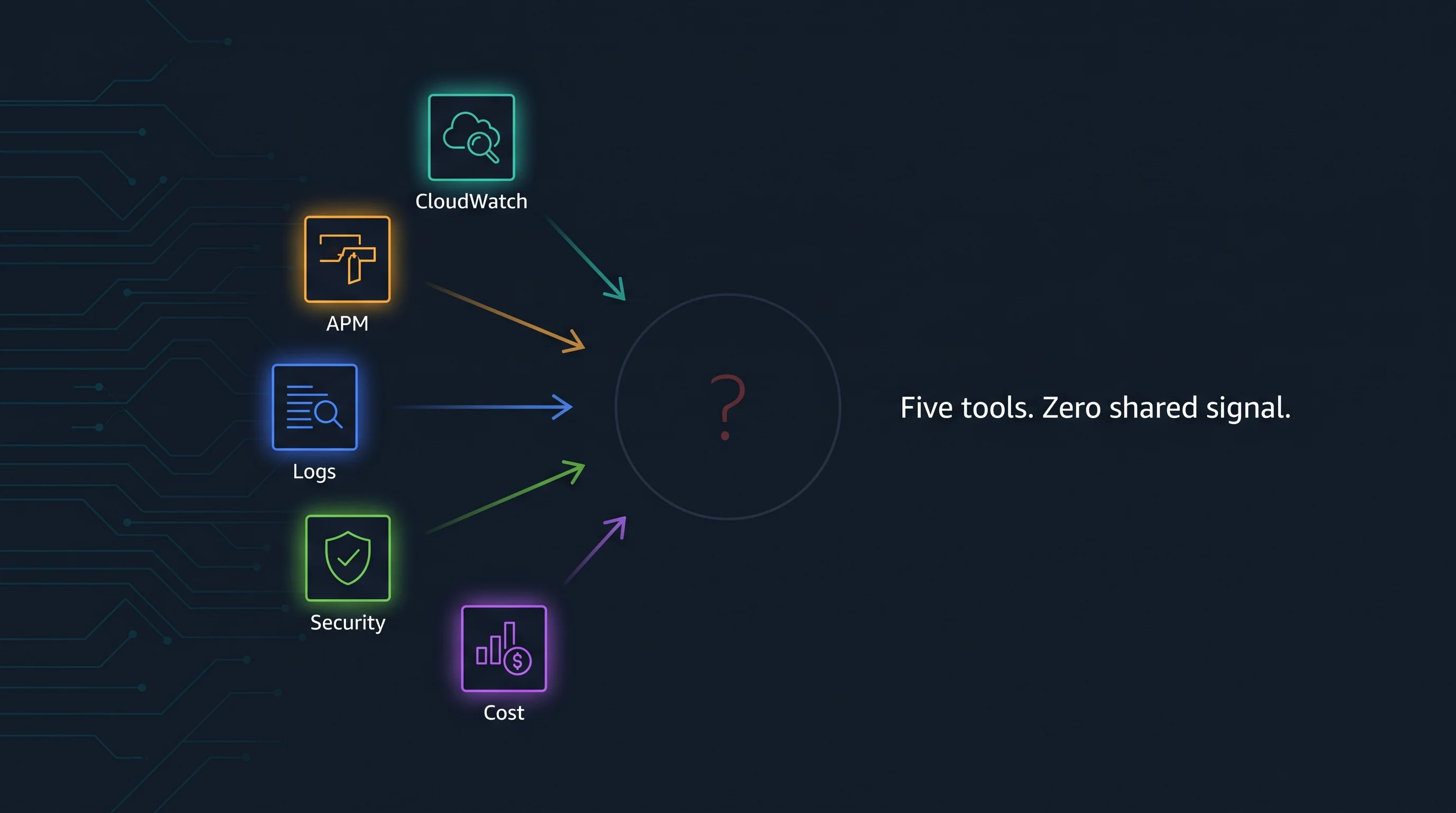
Tool sprawl usually gets discussed as a procurement problem.
Too many vendors.
Too many dashboards.
Too much overlap.
That framing misses the real risk.
Monitoring sprawl is a security blind spot before it is a tooling cost problem.
One shared example captured the pattern well. A company was reportedly spending around $800,000 a month on infrastructure and roughly $320,000 a month on monitoring across CloudWatch, third-party APM, log aggregation, and custom observability layers. Despite that stack, they were still finding obvious waste manually, including orphaned snapshots costing real money.
The most important number in that story is not 40 percent.
It is zero.
Zero unified incident model.
More Signals Do Not Automatically Create More Awareness
Organizations often assume visibility is additive.
- One tool for cloud metrics.
- One for application traces.
- One for logs.
- One for security findings.
- One for cost analytics.
From a buying perspective, that can look mature.
From an operating perspective, it often means the opposite.
Each tool sees one slice.
Each team learns its own dashboard.
Each vendor trains the organization to think in its own data model.
Then a real incident happens:
- CloudWatch shows a usage burst.
- The APM product shows latency.
- The log vendor shows ingestion growth.
- Finance sees a cost anomaly.
- Security sees nothing because no single control stream has crossed its threshold.
The result is not richer visibility.
It is fragmented interpretation.
Fragmented Signals Mean No Shared Incident Model
This is the actual failure.
A company does not have observability just because telemetry exists.
It has observability when teams can turn multiple weak signals into one coherent explanation quickly.
That requires a shared incident model.
Without it, every team sees a local symptom and waits for another team to connect the dots.
That is why monitoring sprawl creates security blind spots.
Many cloud security events do not arrive with a clear security-shaped label.
They arrive as:
- an unusual service bill
- a burst of log writes
- sudden outbound traffic
- a strange retry pattern
- an uptime issue that looks operational at first
If those signals live in different tools owned by different teams, nobody sees one incident.
They see five unrelated anomalies.
Cost Waste and Detection Failure Share the Same Root
The orphaned snapshot example matters because it exposes a familiar pattern.
The organization paid heavily for visibility but still relied on manual discovery for obvious waste.
That means the tooling problem was not lack of data.
It was lack of ownership and synthesis.
The same thing happens in security.
Teams buy broad monitoring coverage and still miss the actual behavior that matters because no one is responsible for turning cost, runtime, identity, and logging signals into one operating view.
This is why SecFinOps should not be treated as a reporting layer added after the fact.
It is an operating discipline for combined signals.
If a log spike, an IAM event burst, and a cost anomaly can describe the same event, the review loop should reflect that.
If it does not, your tools are multiplying data while reducing clarity.
The Hidden Tax of Tool Sprawl
The budget line item is only one part of the cost.
The bigger tax is organizational.
Tool sprawl creates:
- duplicate ingestion for the same event
- duplicate alert policies for the same behavior
- duplicate ownership assumptions
- duplicate contracts with no unified accountability
- duplicated time spent learning interfaces instead of improving control design
The end state is familiar.
Everyone assumes someone else is watching.
That is the worst possible security posture.
It is also the worst possible FinOps posture.
You can spend heavily on instrumentation and still fail to see the system economically.
What Good Looks Like
The answer is not “use one tool for everything.”
That is rarely realistic.
The answer is to operate with one incident model even when multiple tools remain.
That means every meaningful anomaly should be reviewable through the same questions:
- what changed
- what service behavior shifted
- what identity or configuration event overlaps with it
- what did it cost
- who owns the correction
That sounds simple.
It is also where most organizations fail.
They spend on collection and skip correlation. They optimize dashboards and neglect accountability. They increase telemetry coverage without increasing shared understanding.
The Real Question to Ask
If you want to know whether your monitoring stack is helping or hurting, do not ask how many tools you have.
Ask this instead.
If a cost anomaly, a log spike, and a performance regression happened in the same hour, who would combine them into one incident, and where would they do it?
If the answer is unclear, your monitoring sprawl is already a security blind spot.
The invoice is just the first place you noticed it.