
The S3 Lifecycle Rule That Turned Cost Optimisation Into a Six Figure Incident
A lifecycle rule is supposed to lower storage cost. On a bucket with billions of tiny files, it can do the opposite. The deeper lesson is about change authority, not storage tiers.

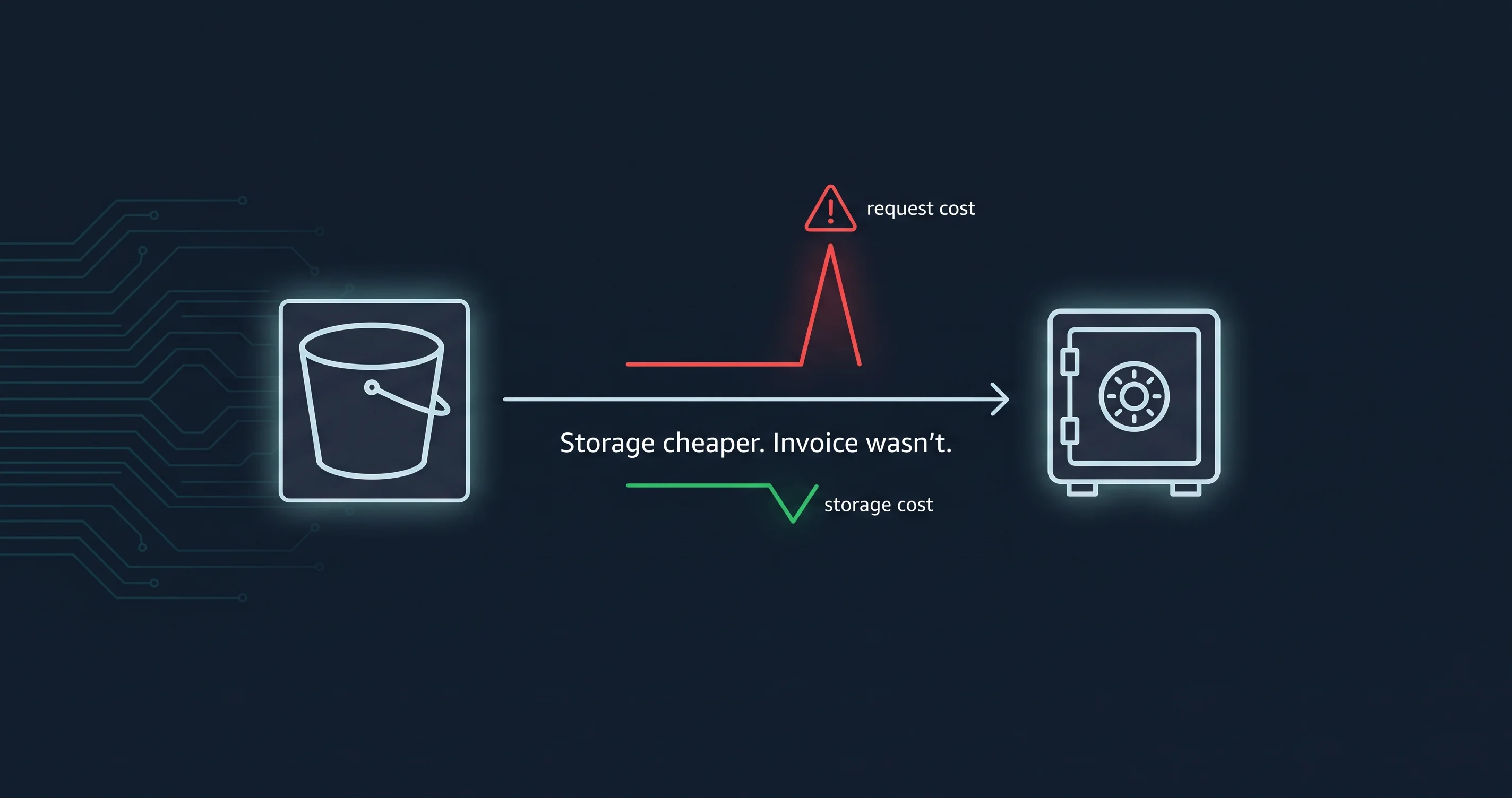
An engineer turns on an S3 lifecycle rule to save money.
That sentence sounds boring. It should.
Lifecycle policies are one of the most normal things you can do in AWS. They are housekeeping. Good hygiene. The kind of change most teams would treat as low drama.
That is exactly why the following story matters.
A security leader recently shared a case where billions of tiny S3 objects were transitioned by lifecycle policy, and the request economics overwhelmed the expected storage savings. Storage got cheaper. The invoice did not. Transition charges and minimum billable object-size assumptions turned a cost-optimization exercise into a six-figure incident.
The pricing details matter. The governance lesson matters more.
This Was Not Really a Storage-Tier Mistake
It is tempting to file this under “S3 pricing is confusing,” shrug, and move on.
That would miss the useful part.
The real issue is that an engineer was able to make a production-scale cost decision without the surrounding controls that should exist around any large-scale infrastructure change.
- No phased rollout.
- No small-sample test.
- No approval gate tied to object count.
- No pre-change estimate of request economics.
The same missing controls would be unacceptable if the change were a security-group rule or an IAM policy expansion. They should be equally unacceptable when the possible blast radius is a six-figure billing event.
Least privilege is not just an access-control concept. It is a cost-control concept. The ability to make large-scope infrastructure changes should be governed in proportion to the financial and operational risk of the change.
Why Tiny Objects Break the Intuition
Most teams think about S3 transitions in terms of storage price per gigabyte.
That mental model works for large objects with predictable access patterns. It breaks on buckets with massive object counts and tiny average object sizes.
Once you are operating at billions of objects, the question is no longer only “what is the cheaper storage class?”
It becomes:
- how many object transitions will this trigger?
- what is the per-request cost of doing that?
- what minimum billable object-size assumptions apply after the move?
- what minimum storage-duration penalties attach to the target class?
That is a different economic model from the one most engineers carry in their heads.
The dangerous part is not that the math is hard. It is that the change can look operationally safe while the billing model is not understood.
A CISO Told the Story. That Is the Point.
The most interesting part of the original story is not the storage class. It is who told it.
A CISO.
That should tell you something about where the category is moving. Security leaders are being forced to care about cloud economics because bad cloud-economics decisions increasingly come from the same governance gaps that create security incidents.
An engineer with broad production access, no rollout guardrails, and no requirement to estimate impact before acting is a security risk and a cost risk at the same time.
Those are not two separate failures. They are the same failure seen through two dashboards.
What the Bill Actually Looked Like
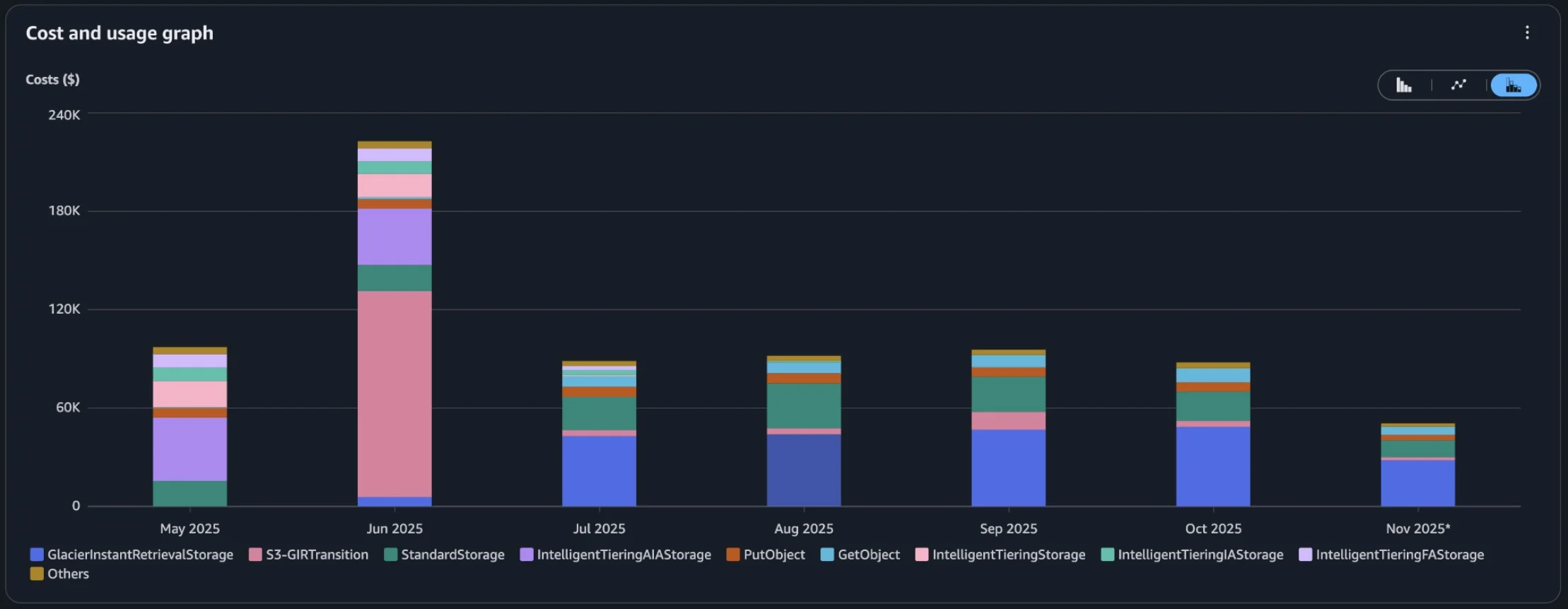
This is not a hypothetical. The Cost Explorer breakdown below shows the June spike in real numbers. The S3-GIRTransition bar dominates that month, dwarfing every other cost category.
The comparison chart below reconstructs the recovery path using the monthly billing data, the AWS credit that was later applied, and the expected spend trajectory without the transition.
For a growing company, a $125,794 surprise in a single month is not just a billing problem. It is a cash flow event. It can delay hiring, slow a product roadmap, or force a conversation with investors that nobody wanted to have. This is the real cost of a governance gap. Not the abstract risk, but the concrete financial pressure it puts on a team that is already stretched.
AWS later provided a $60K credit. That matters, and it is worth saying clearly: when something goes wrong at this scale, contacting your AWS account team is the right move. AWS may sometimes work with customers when the spike comes from a misconfiguration rather than deliberate overuse. The credit absorbed a meaningful portion of the initial hit and made the recovery path more manageable.
The team also tightened the transition window from 90 to 30 days, which added $10,873 in September but accelerated the path to ROI. By October, the team had materially narrowed the gap, and the monthly savings trajectory suggested the transition cost would be paid back shortly after, with recurring monthly savings in the $20K to $25K range.
That is what recovery looks like when the team responds well. But the AWS credit is not a safety net you can plan around. It helped once. The governance fix is what prevents needing it again.
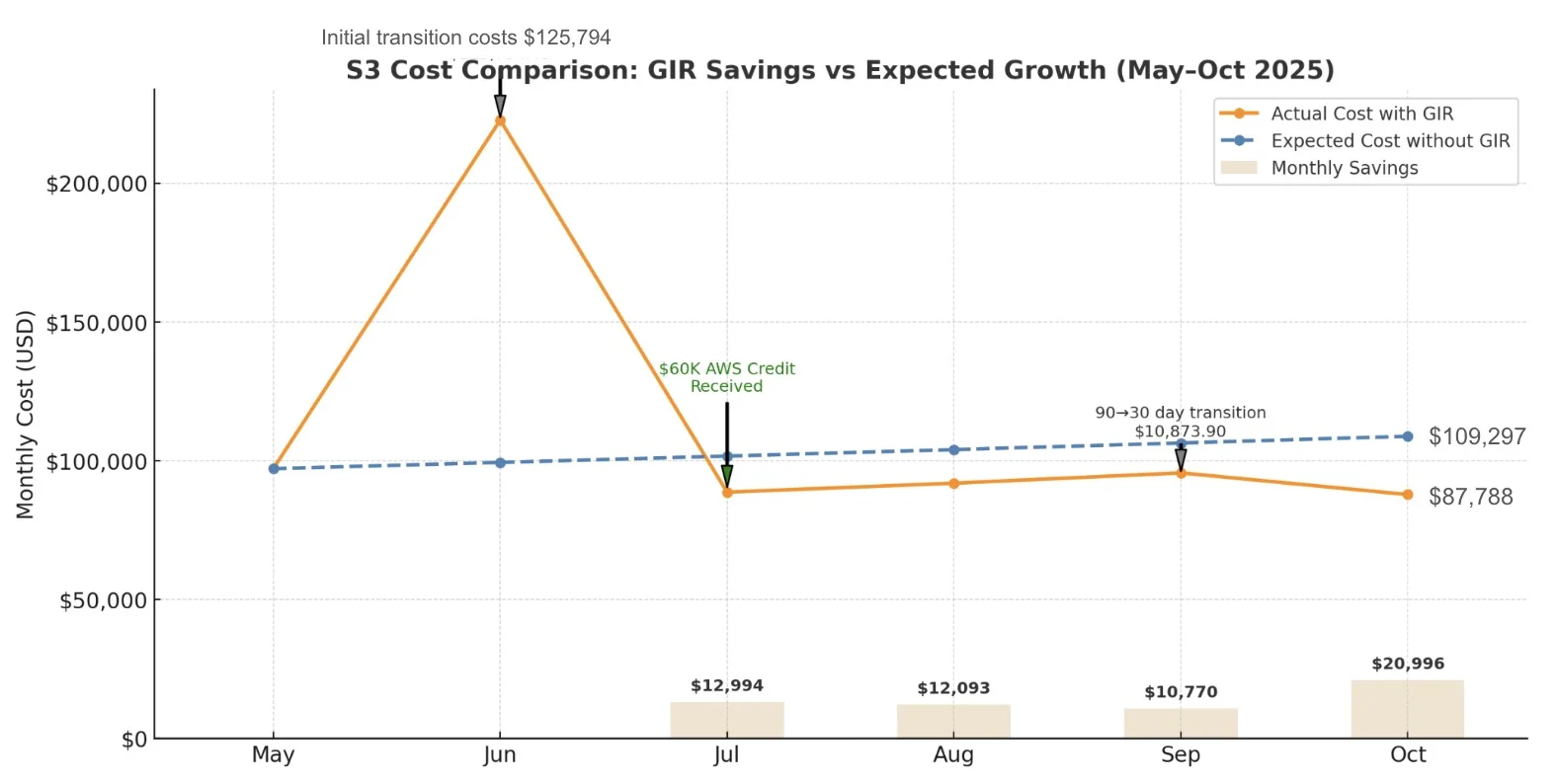
The spike and the recovery were both visible in the billing data, but only once the team started reading the bill as a governance signal instead of just a cost report.
What Good Change Governance Looks Like
There are practical ways to make this class of mistake less likely.
Measure before transition. Run S3 Inventory. Group by object count and size bands. If the average object is tiny, the transition economics need explicit review.
Model request cost separately from storage cost. Do not approve a lifecycle transition based only on lower per-GB pricing. For high-object-count buckets, request charges can dominate.
Add size filters to lifecycle policies. Not every object deserves the same storage policy. Buckets with mixed object sizes should be segmented accordingly.
Test the policy on a small prefix first. Roll out on 1% of the estate, verify billing impact, then expand.
Gate high-object-count policy changes. An engineer should not be able to apply a global lifecycle rule to a bucket with billions of objects without a second review.
None of this is bureaucratic overkill. It is the same discipline teams already accept for high-impact security changes.
The Missing Control Was Governance, Not AWS Pricing
To be precise, this is not a story about AWS withholding controls. The platform provides the building blocks. Lifecycle filters exist. Cost anomaly detection exists. Budgets exist. Inventory exists.
The lesson is sharper than “AWS pricing is complicated.”
The lesson is that cost management is part of change management.
If a team treats cloud economics as something to inspect only after deployment, then every operationally normal change is one bad assumption away from becoming a financial incident.
Fact-check: Did AWS Change Anything Here?
Yes. AWS tightened default lifecycle-transition behaviour in late 2024 with a default minimum object-size threshold for transitions, which reduces one class of failure. That helps. It does not remove the underlying governance problem.
You can still apply broad policies to the wrong data set. You can still ignore request economics. You can still let engineers make globally expensive changes without a review model.
That is why this is a SecFinOps story, not just an S3 story.
Try CostObserver. Read-only access, no credit card, connects in minutes. Or explore the demo without signing up.