
Where SecFinOps Starts
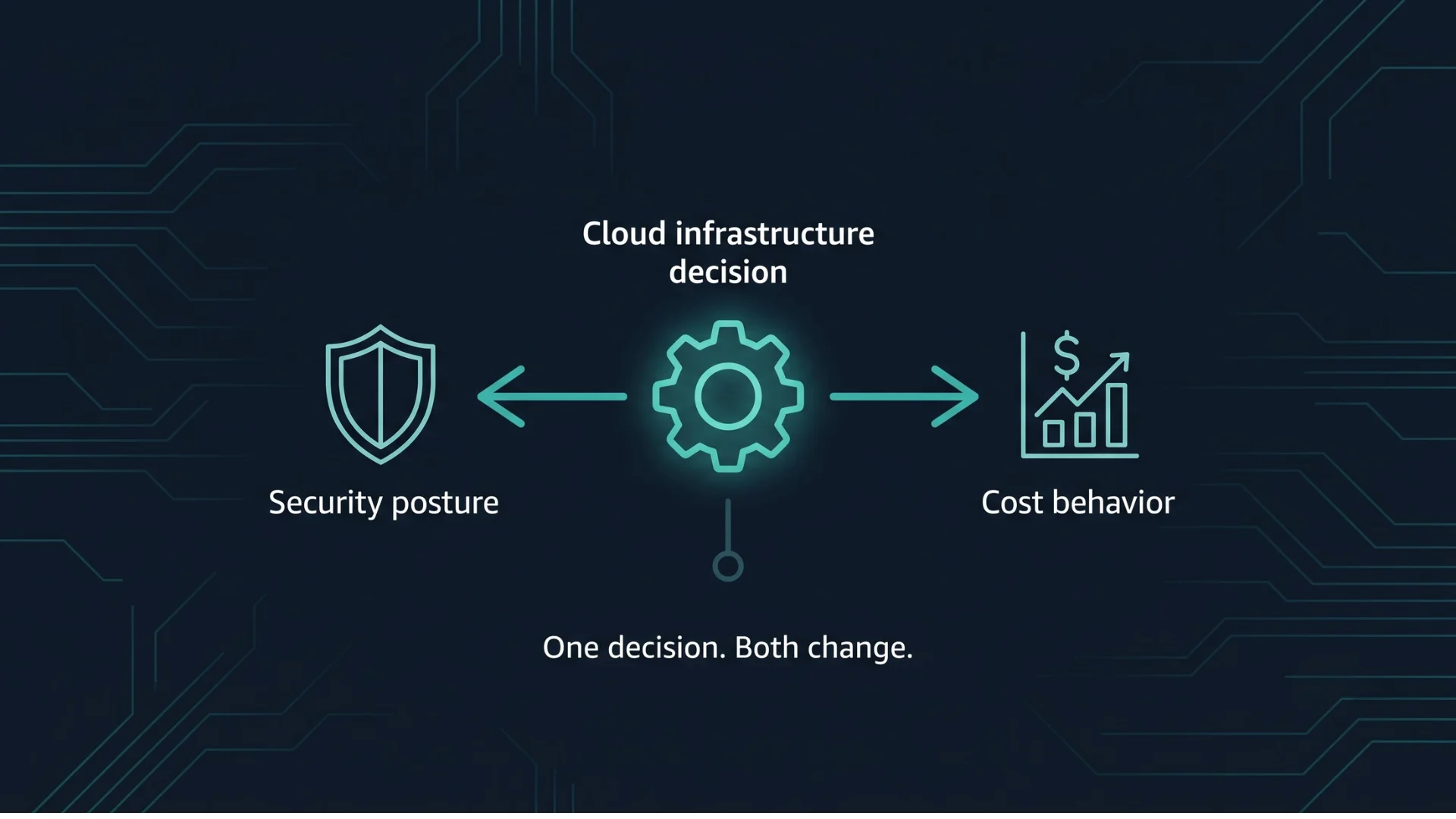
SecFinOps does not start with a dashboard or a category definition. It starts the moment one cloud decision changes both financial behavior and security posture at the same time.

People often ask where SecFinOps starts.
The question sounds strategic, but it usually hides a tactical assumption.
Teams imagine the answer is a dashboard, a tooling stack, or a new process layer between finance and security.
I do not think that is right.
SecFinOps starts much earlier.
It starts the moment one cloud decision changes both financial behavior and security posture at the same time.
That is the moment the old org chart stops being an accurate model of the system.
The Category Exists Because the Cloud Collapses Boundaries
In older operating models, it was easier to separate subjects.
Security reviewed controls.
Finance reviewed cost.
Operations reviewed uptime.
Those boundaries were never perfect, but they were at least somewhat workable when infrastructure changed more slowly and scaling behavior was less automatic.
Cloud systems broke that comfort.
One configuration choice can alter exposure, logging volume, retry behavior, and spend in the same move.
One permission boundary can define both security blast radius and economic blast radius.
One automation loop can become a reliability problem, a security problem, and a billing problem before the next human review cycle begins.
That is why SecFinOps is not a slogan looking for a market.
It is a response to the fact that cloud behavior no longer respects the organizational separation between cost events and security events.
The Wrong Starting Point Is the Invoice
Most organizations encounter the problem late.
They notice a cost spike.
Then they ask whether security should be involved.
Or they notice a suspicious behavior pattern.
Then they ask whether anyone can map its financial impact.
Both responses assume cost and security are separate stories being correlated after the fact.
That is the wrong starting point.
The right starting point is the decision itself.
If a cloud change can materially alter cost behavior and security posture together, then the review model should reflect that before the change is trusted.
SecFinOps starts there.
At the boundary where architecture decisions become combined economic and control decisions.
The Smallest Useful Definition
A lot of categories become bloated because people try to define them through every possible use case.
I prefer a smaller definition.
SecFinOps starts wherever:
- a permission decision changes financial exposure
- an automation decision changes security exposure
- a runtime anomaly must be interpreted through both cost and control signals
That definition is useful because it is operational.
It tells teams where to look.
It tells them which decisions deserve combined review.
And it avoids the trap of making the category feel abstract.
Why This Matters for Founders and Leaders
If you are building products or operating teams in this space, the opportunity is not simply better reporting.
The opportunity is to help organizations govern the surfaces where these decisions overlap.
That means helping teams answer questions like:
- what behavior can this identity create economically
- what security implication hides inside this cost anomaly
- what architectural boundary would prevent both problems at once
- who owns the response when the signal crosses functions
Those are not niche questions anymore. They are becoming basic cloud operating questions.
The teams that learn to answer them early will run faster and safer than the ones still treating finance and security as separate downstream reviews.
SecFinOps Is Not a Department
This point matters.
SecFinOps should not become a new silo.
If it does, it will recreate the exact fragmentation it is supposed to solve.
It is better understood as a lens on cloud decisions that already cross functional boundaries.
A good operating model does not insert more distance between engineering, finance, and security.
It shortens the loop between them when the architecture demands it.
That is why the category starts with a decision, not with a team name.
The Practical Test
If you want to know whether a situation belongs in SecFinOps, ask one question.
Did this cloud decision change both what the system can cost and what the system can risk?
If the answer is yes, SecFinOps has already started whether the organization has named it or not.
The only remaining question is whether the operating model is mature enough to respond accordingly.