
Why Ownership Fails Even in Mature Cloud Teams
Mature teams rarely fail because they lack dashboards or technical skill. They fail because cost, security, and change decisions run on different clocks, in different tools, under different incentives.

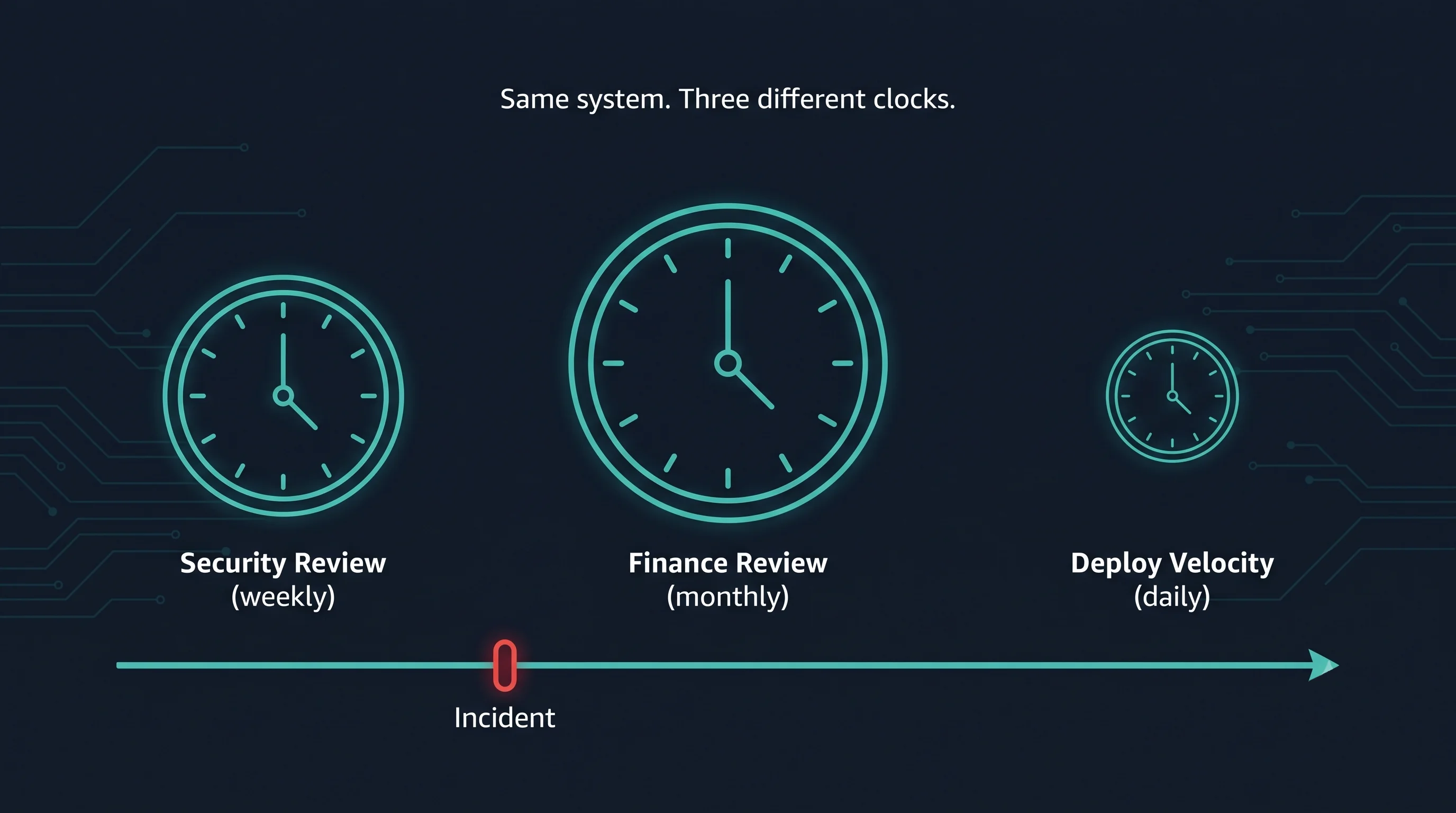
There is a comforting story mature cloud organizations tell themselves:
- We have experienced engineers.
- We have dashboards.
- We have controls.
- We have cost reviews.
- We have security processes.
So if something expensive or risky still gets through, the assumption is usually that someone made an unusual mistake.
I do not think that is the real pattern.
Ownership often fails in mature teams for a more structural reason.
Cost ownership, security ownership, and change ownership are usually operating on different clocks, in different tools, with different incentives.
The incident only makes that split visible.
Mature Teams Usually Have Competence. They Often Lack Alignment.
This is what makes the problem easy to miss.
Immature teams fail noisily. They do not have enough process, enough instrumentation, or enough repetition.
Mature teams fail more quietly.
They often have all the components that should create control:
- a platform team reviewing architecture
- a security team reviewing risk posture
- a finance or FinOps loop reviewing spend
- engineering managers reviewing delivery speed and roadmap impact
Every function is staffed by serious people. Every function is acting rationally within its own frame.
And still the organization produces cloud decisions that nobody actually owns end to end.
That is the important phrase.
End to end.
Not who approved a ticket.
Not who deployed a change.
Not who received the bill.
Who owned the full operational consequence when the decision altered cost behavior and security posture at the same time?
That is where mature teams often have no answer.
Different Rhythms Create Control Gaps
Cloud systems move on operational time.
Infrastructure changes can happen in minutes.
Permissions change instantly.
Automation can amplify a bad assumption before the next stand-up.
But the organizational reviews around those systems rarely move at the same speed.
Security reviews may run weekly.
Finance sees the invoice later.
Leadership sees the impact at month-end.
An engineer deploying on Tuesday afternoon is operating inside a much faster loop than the people who eventually inherit the consequences.
That mismatch creates a control gap even when everyone is capable.
The company looks governed from the outside.
Inside the decision loop, it is fragmented.
Different Tools Reinforce Different Stories
The tooling split makes the problem worse.
Cost anomalies are reviewed in one system.
Security events are reviewed in another.
Runtime symptoms show up somewhere else.
Changes are tracked in ticketing and deployment systems that rarely become the center of incident interpretation.
So the same event gets translated four different ways.
Platform calls it a bad deploy. Security calls it a control gap. Finance calls it unexpected spend. Leadership calls it lack of accountability.
All four may be true.
The problem is that no shared operating model forced those views together early enough to matter.
This is why mature teams still get surprised.
Not because they had no data.
Because the data never became one decision in time.
Incentives Quietly Break Ownership
The last part is incentives.
Engineering is rewarded for shipping.
Security is rewarded for reducing exposure.
Finance is rewarded for explaining or controlling spend.
These are all reasonable goals.
They only become dangerous when a cloud decision affects all three and nobody is measured on the combined outcome.
Then the organization unintentionally trains people to optimize locally.
A team can make a fast delivery decision that appears operationally successful.
Security may not object because no immediate policy violation is visible.
Finance does not see the outcome until after the spend lands.
By the time the incident is reviewed, each team is looking backward from a different responsibility boundary.
That is not absence of ownership.
It is ownership that was never designed to overlap where the cloud actually behaves.
The Cloud Does Not Respect Your Org Chart
This is the core idea behind why I keep coming back to SecFinOps.
The cloud does not care which team owns the meeting.
One IAM decision can change blast radius and spending behavior simultaneously.
One deployment can alter reliability, logging cost, and exposure in the same hour.
One missing boundary in an event-driven workflow can become both a security weakness and a financial incident.
The system behaves as one surface.
Most teams govern it as three separate subjects.
That is why ownership fails even in mature environments.
The failure is not lack of sophistication.
It is the mismatch between integrated systems and separated accountability.
What Mature Ownership Actually Requires
If teams want real ownership, the fix is not another dashboard.
It is a tighter decision loop around changes that can affect cost and security together.
That usually means:
- Reviewing material cloud changes through one combined operating lens.
- Making service owners responsible for both runtime and economic consequences.
- Treating anomaly response as a cross-functional operating motion, not a finance escalation.
- Asking before deployment what control failure would make this change expensive at cloud scale.
That last question matters because it forces the right conversation early.
Not after the bill.
Not after the alert.
Before the architecture is trusted.
Ownership Does Not Fail at the Invoice
By the time an incident shows up on the invoice, ownership already failed earlier.
It failed when decision velocity outran review velocity.
It failed when cost, security, and operational context stayed in different tools.
It failed when each team acted rationally inside its own incentive boundary and nobody owned the combined result.
That is the uncomfortable lesson mature teams need to accept.
Competence is not the same as control. Control only exists when the people making cloud decisions are accountable for the full shape of the outcome.
Without that, even a mature team is just a collection of capable specialists hoping the gaps between them stay cheap.